
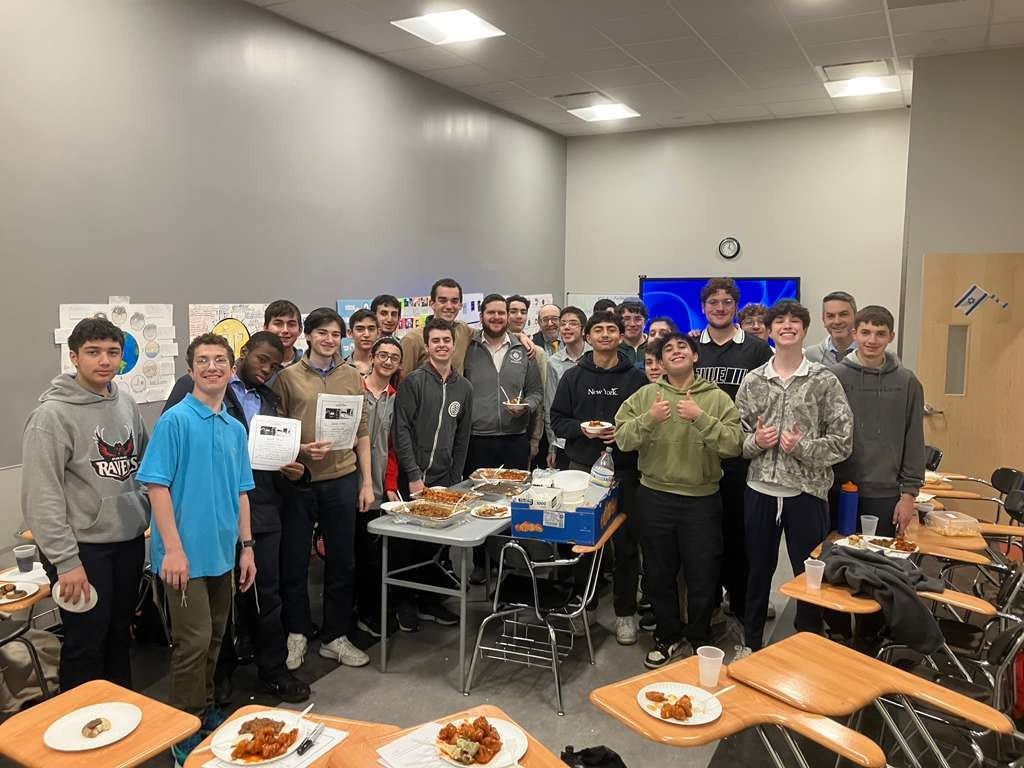
It is with a heavy heart that we had our last Book Chat of the year on May 13th. But despite the bittersweet undertones, it was a meeting filled with epic discussion and insight. Featuring two short stories, Herbert Goldstone's "Virtuoso" and Ray Bradbury's "The Pedestrian," the group got comfortable in Room 213 with hot chicken poppers, cholent, kugel, and assorted pastries.
In examining the first story, Dr. Goldman began by playing a short composition on his laptop. "Sounds good? " he asked. The members nodded. "That was AI. " That set the tone for the discussion about the short story which centered around a robot who performs Beethoven's Appassionata without ever hearing it, with such beauty that he brings his master, the "Maestro," to tears. This raised the question: what is the meaning of music, and will AI eventually take over music itself? With that on the table, the room went around exchanging ideas in tandem with the story's deeper meaning.
A particularly interesting point of discussion focused on the meaning of "Virtuoso" and "Maestro. " As the group came to understand it, a virtuoso is someone with immense technical musical skill, while a maestro is someone with a deep emotional understanding of music, often expressed through conducting and interpretation. In the story, the "Virtuoso," and thus the title character, is the robot itself, a being with flawless technique but no soul. In a stunning juxtaposition, the piece the robot performs is the Appassionata, literally meaning "deeply emotional. " So the question became: is the emotion genuine, or is it simply a formula capable of imitating emotion?
The room buzzed with discussion. Someone pointed out that composers often have identifiable styles of chords, motifs, chromatics, and scales, and that even in the late 80s and early 90s, there were computer programs capable of reproducing compositions in a composer's style by following patterns and attributes. Another member brought up the international Chopin Competition, perhaps the most prestigious piano competition in the world, where every pianist performs the same compositions and technically plays them perfectly. So what are the judges actually grading? Emotion, interpretation, and individuality. Perhaps, as the group concluded, AI may be able to follow formulas and create beautiful music, but there will always be a difference in the emotion brought forth from a human soul.
Moving on to the second story, "The Pedestrian," the narrator follows a man in the year 2053 walking alone on the street at night when he is approached by a robotic cop, who asks him what business he has being outside so late. When he responds that he is "just walking," the cop questions why he does not stay inside watching his viewing screens and ultimately declares him insane. The final glimpse we get of him is as he is shipped off to a mental institution.
The story was connected to a concept involving "the death of the front porch" in modern America. In earlier generations, people would sit outside, talk to neighbors, observe the world around them, and simply exist within their communities. In Bradbury's future, however, everyone is sealed inside, hypnotized by screens and detached from the outside world. The pedestrian is considered insane not because he is dangerous, but because he still desires reflection, wandering, and human connection with the world around him. What do you do? The robot asks, "I'm a writer. " "Okay, Unemployed". The story becomes less about technology itself and more about the slow disappearance of quiet observation and authentic living.
Following the discussion, the members felt satisfied and grateful for the meaningful insights they had gained that day and especially throughout the year. Book Chat is an amazing opportunity to reflect deeply on literature and grow from it in unique ways. Thank you to Dr. Goldman for running the Book Chat and for making every meeting something exciting, thoughtful, and creative.