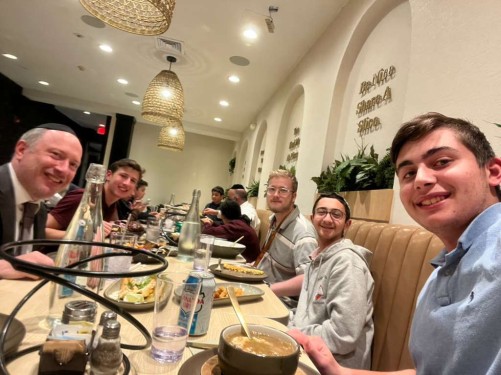
L ast month, the annual Model Beis Din competition was held at Lander College, hosting schools from across the country for an exciting debate on profound halachic dilemmas in the modern world. This year’s case featured a heartbreaking story involving a father with kidney failure and his mentally deficient son. The complexity of the case brought in countless sugyot from the Gemara, along with contemporary sources, to help navigate such a difficult question. The Rambam Model Beis Din team, the “Rambam Rambams,” performed exceptionally well and celebrated their success with a team dinner this past Wednesday night. The team, along with their wonderful coach Rabbi Zev Cinamon, went to Upper Crust, where they enjoyed pizzas and pastas, topped off with a Dubai chocolate lava cake for dessert. Thank you to Rabbi Cinamon for being our Rabbi and Mentor, and thank you to Rambam for generously sponsoring the dinner and allowing students to pursue their passion while engaging in meaningful and friendly competition. Cremor 5786 Avi Pearlman (Senior) everyone involved, and we hope we can continue the tournament for many more years to come. Editor’s Note: A huge thanks really does have to go to Avi Pearlman, who shepherded this tournament along and brought a real Rambam favorite back to its rightful place as a top tournament! Moe Goldstein (Junior) T his past Thursday, Rambam Mesivta hosted Shalom Task Force’s Julie Feinberg for a meaningful Purple Day presentation on healthy and unhealthy relationships, as well as the importance of knowing when and how to seek support. She began by explaining the spectrum of relationships and how to recognize early red flags, such as constant criticism, lack of support, and feeling like you are “walking on eggshells.” She also noted that there are often multiple perspectives in any situation, but that does not mean harmful behavior should be ignored. Arms. Feinberg introduced the acronym T. R. U. S. T., which stands for trust your gut, tune in, reflect, understand your needs, stay curious, and take action. The message emphasized staying aware of one’s emotions, recognizing patterns, and not brushing issues aside. The presentation then shifted to a more serious question: when does a relationship become abusive? Arms. Feinberg explained that a major warning sign is when a person’s home, which should be a safe haven, begins to feel unsafe. She shared how people sometimes minimize situations before they escalate, and stressed the importance of recognizing warning signs early. She defined domestic abuse as a pattern of behavior used by one partner to gain power and control over another, and explained that it can take many forms, including physical, verbal, emotional, sexual, financial, psychological, digital, and social isolation. She also emphasized that no community is immune and that awareness and education are critical. Arms. Feinberg then compared healthy and unhealthy relationships. In a healthy relationship, individuals can be open, respectful, and self-assured, and are able to communicate and work through conflict. In contrast, unhealthy relationships often involve fear, pressure, or con
Emor · May 1, 2026·7 Iyar 5786·Published May 1, 2026
News
A Model Beis Din Dinner
By Moe Goldstein · May 1, 2026