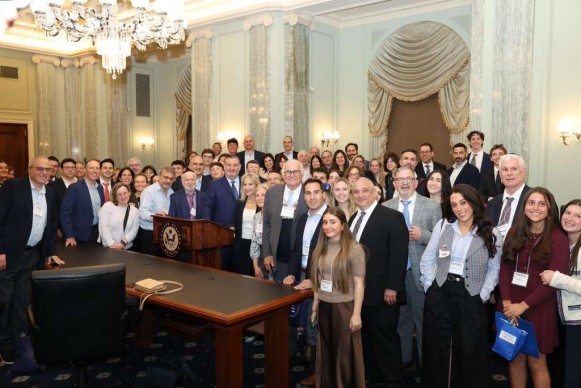
T his past week, Rambam sent a delegation to join NORPAC on their annual Mission to Washington. The group had the extraordinary opportunity to meet with multiple members of Congress to discuss important issues relating to antisemitism, Israel, and current global affairs. Among those they met were Congresswoman Nicole Malliotakis, Congressman Jeff Hurd, and Sophia Seid, Chief of Staff to Congresswoman Ashley Hinson. Some delegates also had the opportunity to hear from Senator Ted Cruz. By the end of the day, NORPAC had met with hundreds of members of Congress and made a significant impact in raising awareness about antisemitism, support for Israel, and the conflict involving Iran. Thank you to Rabbi and Rebbetzin Friedman, Tzviki Gaerman, Ephraim Ganchrow, and Avi Lax for taking the time to participate and make a difference. A special thank you as well to Mr. Josh Justic for leading the group and capturing the experience through photos. Cremor 5786 Avi Lax (Senior) Continued on next page... I t is with a heavy heart that we had our last Book Chat of the year on May 13th. But despite the bittersweet undertones, it was a meeting filled with epic discussion and insight. Featuring two short stories, Herbert Goldstone’s “Virtuoso” and Ray Bradbury’s “The Pedestrian,” the group got comfortable in Room 213 with hot chicken poppers, cholent, kugel, and assorted pastries. In examining the first story, Dr. Goldman began by playing a short composition on his laptop. “Sounds good?” he asked. The members nodded. “That was AI.” That set the tone for the discussion about the short story which centered around a robot who performs Beethoven’s Appassionata without ever hearing it, with such beauty that he brings his master, the “Maestro,” to tears. This raised the question: what is the meaning of music, and will AI eventually take over music itself? With that on the table, the room went around exchanging ideas in tandem with the story’s deeper meaning. A particularly interesting point of discussion focused on the meaning of “Virtuoso” and “Maestro.” As the group came to understand it, a virtuoso is someone with immense technical musical skill, while a maestro is someone with a deep emotional understanding of music, often expressed through conducting and interpretation. In the story, the “Virtuoso,” and thus the title character, is the robot itself, a being with flawless technique but no soul. In a stunning juxtaposition, the piece the robot performs is the Appassionata, literally BOOK CHAT FINALE: TWO SHORT STORIES T his past week Rambam Mesivta’s 501Book Challenge hit 501 books! Each book is marked with a rating some minor commentary and a donation to support Israel! Thank you to all who participated and we look forward to seeing everyone at Dr. Goldman’s year-end BBQ and Ladder-Toss Tournament! All-Star Awards will be distributed! Shoutout to Akiva Faska, the Most Valuable Reader, who, for the second year in a row read over 100 books!
Bamidbar · May 15, 2026·28 Iyar 5786·Published May 15, 2026
News
NORPAC Mission to Washington!
By Avi Lax · May 15, 2026